Vatican Museums FAQs

The most asked questions have short answers. A standard ticket is €25 online and includes the Sistine Chapel, since the chapel is the last room of the museums rather than a separate attraction. The museums open Monday to Saturday from 8:00 am, with the last entry at 6:00 pm, and are closed on Sundays apart from the free last Sunday of each month. The dress code covers shoulders and knees, St. Peter's Basilica is free but separate, and you do not need a passport to get in. Everything else is answered below, grouped by topic.
Vatican Museums FAQs tend to repeat, because almost every first-time visitor arrives with the same handful of questions: what a ticket covers, whether the Sistine Chapel is included, when to go, what to wear, and how the museums relate to St. Peter's and Vatican City.
Getting these straight before you book saves money and a lot of confusion at the door.
This guide pulls the common questions into one place and answers them in four groups: Tickets and Tours, Plan Your Visit, What to See, and About the Vatican.
📋 In This Guide
🎟 Top Vatican Tickets & Tours
Tickets and Tours
How much are Vatican Museums tickets?
A full adult ticket is €20, or €25 online once the €5 booking fee is added. Reduced entry is €8 for ages 6 to 18 and students under 25, and children under 6 are free. Our ticket prices guide lists every option.
Do I need to book tickets in advance?
Yes, you need to book tickets in advance. Walk-up tickets are limited and the queue can run past an hour in peak season. Booking a timed skip-the-line entry ticket ahead of time is the simplest way in.
What does a Vatican Museums ticket include?
The Vatican Museums ticket covers the full museum route and ends with the Sistine Chapel. The Sistine Chapel is always included, as it is the last room of the museums, so there is no separate chapel ticket.
Is the Sistine Chapel included or a separate ticket?
Sistine Chapel is included in every ticket and tour. You reach it by walking through the museums to the end, and there is no Sistine Chapel-only ticket.
What is the official website to buy tickets?
The official ticket office is tickets.museivaticani.va, reached from the main site museivaticani.va. Our official website guide explains how to book there and how to spot look-alike resellers.
Can I buy tickets at the door?
You can buy tickets at the door, but it is risky. On-site tickets are €20 but limited, and the line is long, so in busy months the day can sell out. Booking online is safer and only €5 more.
Do I need skip-the-line Vatican tickets?
Yes, you need skip-the-line Vatican tickets. A standard ticket still means queuing in the general line, while a skip-the-line ticket lets you go to a shorter priority entrance. In peak season it saves the most time.
Is a Vatican guided tour worth it?
Vatican guided tour is worth it for many first-time visitors. The museums are vast and short on signs, so a guide steers you to the highlights and explains them, and some tours use the shortcut from the Sistine Chapel into St. Peter's. Our guided tour guide compares the options.
Can I cancel or change my ticket?
It depends where you booked. Official tickets are non-refundable, while most licensed platforms offer free cancellation up to 24 hours before. Check the terms before you pay.
Do tickets include St. Peter's Basilica?
No. St. Peter's Basilica is a separate building with its own entrance. It is free to enter, but you have to pass through a long queue. The dome climb costs extra. Our St. Peter's Basilica tickets guide covers it.
Can I visit the Vatican Museums for free?
Yes, on the last Sunday of each month, you can visit the Vatican Museums for free, from 9:00 am with the last entry at 12:30 pm. These free tickets cannot be booked online, so you queue on the day. See our free entry last Sunday guide.
Plan Your Visit
What are the Vatican Museums opening hours?
Monday to Saturday, 8:00 AM to 6:00 PM, with the last entry at 4:00 PM, and often later closing at 8:00 PM with the last entry at 6:00 PM in busy periods. There are also Friday evening openings in season. Our opening hours guide has the current times.
Are the Vatican Museums open on Sundays?
No, Vatican Museums are closed on Sundays, with one exception: the last Sunday of each month, when entry is free from 9:00 AM to 2:00 PM. They also close on a number of religious holidays.
When is the best time to visit?
The best time to visit Vatican Museums is early on a weekday, at the first slot of the day, and is quietest. Tuesday to Thursday are calmer than Mondays and Saturdays, and the Friday evening openings are a good low-crowd option. Our best time to visit guide breaks it down by month.
How do I get to the Vatican Museums?
The nearest metro is Ottaviano-San Pietro on Line A, about a 10 minute walk. Several buses and tram 19 stop nearby. Our how to get there guide covers the metro, bus, and car.
Where is the Vatican entrance?
The Vatican entrance is on Viale Vaticano, on the north side of Vatican City, which is a different place from St. Peter's Square. Our entrance guide shows exactly where.
What is the Vatican dress code?
Shoulders and knees must be covered for both men and women. No vests, short shorts, or short skirts, or you may be turned away. Our dress code guide has the details.
How long should I spend at the Vatican Museums?
About 2 to 3 hours for the highlights and the Sistine Chapel, or half a day if you add St. Peter's. Rushing it in under 90 minutes tends to disappoint.
Can I bring a bag or backpack?
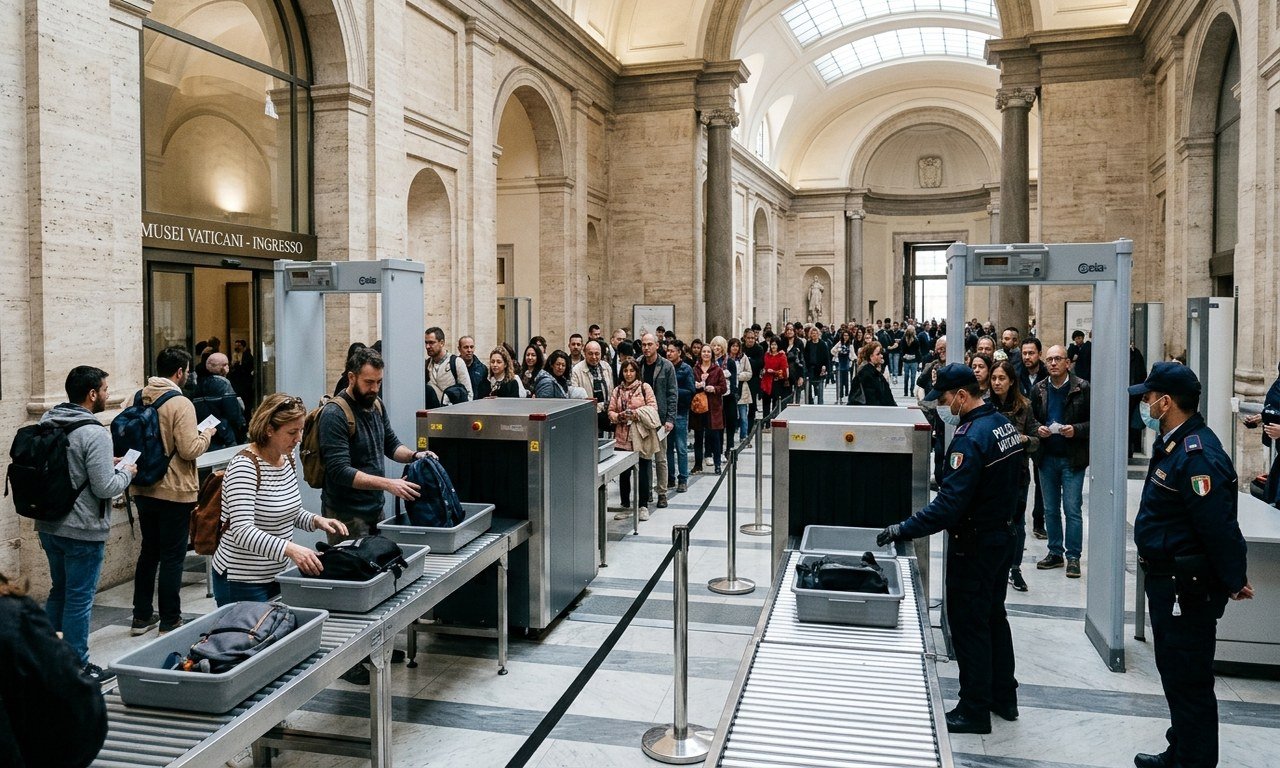
Small bags are fine. Large bags, backpacks, and suitcases are not allowed inside and must be left at the free cloakroom. Selfie sticks and tripods are also banned.
Is there a cloakroom and toilets?
Yes. There is a free cloakroom near the entrance for larger bags and coats, and toilets, cafes, and a bookshop inside. There is no re-entry once you leave.
Can I take photos inside?
Yes in the general galleries, without flash, and no tripods or selfie sticks. Photography is not allowed at all in the Sistine Chapel.
Are the Vatican Museums wheelchair accessible?
Yes, with lifts and step-free routes on the main galleries, and free wheelchair loan. Visitors with a disability of 67% or more, plus one companion, enter free.
Can I visit with kids and strollers?
Yes. Children under 6 are free, strollers are allowed, and there are family-friendly highlights like the animal statues and the Egyptian mummies.
What to See
What is Sistine Chapel?
Sistine is the chapel at the end of the museum route, famous for Michelangelo's ceiling and his Last Judgment on the altar wall. It is the climax of the visit and is included in every ticket.
What are the must-see highlights?
The Sistine Chapel, the Raphael Rooms, the Gallery of Maps, the Pinecone Courtyard, and the spiral staircase at the exit are the big five. Our top things to see guide lists more.
What are the Raphael Rooms?
Four rooms painted by Raphael and his workshop, the highlight being the School of Athens. They come shortly before the Sistine Chapel on the route.
What is the Gallery of Maps?
A 120 metre corridor lined with 16th-century painted maps of Italy under a gilded ceiling. It is the long golden hall you see all over social media.
What is the spiral staircase?
The double-helix staircase at the exit, designed by Giuseppe Momo in 1932, with two ramps that never cross. It is the last thing you see and the most photographed spot after the Sistine Chapel.
How many artworks are in the Vatican Museums?
Around 20,000 works are on display across the public route, from a far larger collection, built up over five centuries.
What is the Pinacoteca?
The Vatican's painting gallery, with works by Raphael, Caravaggio, and Leonardo da Vinci. It sits slightly off the main route, so it is quieter and easy to miss.
Can I see the Pope at the Vatican?
Not inside the museums. The Pope gives a general audience most Wednesdays in St. Peter's Square and the Angelus blessing on Sundays, both free and separate from a museum visit.
What is the Vatican Necropolis or Scavi tour?
The ancient burial ground under St. Peter's Basilica, including what is believed to be St. Peter's tomb. It is seen only on the separate, limited Scavi tour, which must be booked in advance and bans photography.
About the Vatican
Is Vatican City a country?
Yes. Vatican City is an independent city-state inside Rome, the smallest country in the world, and the seat of the Catholic Church.
What is the difference between Vatican City and the Vatican Museums?
Vatican City is the whole city-state, which includes St. Peter's Basilica, the square, and the gardens. The Vatican Museums are one part of it, the museum complex that ends in the Sistine Chapel. Our Vatican vs Sistine guide untangles it.
Do I need a passport to enter Vatican City?
No. There is no border check to enter St. Peter's Square or the museums, and you do not show a passport. Just bring an ID that matches your ticket.
Is the Vatican in Rome?
It sits inside Rome but is its own country, surrounded by the city. You cross into it without noticing, as there are no gates in the open areas.
How old are the Vatican Museums?
Vatican Museums date back to 1506, when Pope Julius II put his sculpture collection, starting with the Laocoön, on public view. They have grown ever since.
Who runs the Vatican Museums?
Vatican Museums are owned and run by the Holy See, the government of Vatican City, not by Italy. Ticket income helps fund the upkeep of the collection.
What is St. Peter's Basilica?
The great church beside St. Peter's Square, one of the largest in the world, built over the tomb of St. Peter. It is free to enter and separate from the museums.
What currency and language does the Vatican use?
The currency is the euro, and Italian is the official language, though staff and signs commonly use English too.
Related Vatican Visitor Guides